Bathroom remodel cost Montgomery County PA homeowners should plan for can vary considerably from one project to another. A simple bathroom update can cost substantially less than a complete renovation that involves demolition, new plumbing, electrical work, custom tile, upgraded fixtures, and changes to the bathroom layout.
For homeowners in Montgomery County and surrounding southeastern Pennsylvania communities, a reasonable starting point for a professionally completed bathroom renovation in 2026 is approximately $15,000 to $40,000 for many standard projects.
Larger primary bathrooms, extensive renovations, custom tile work, premium fixtures, or projects involving significant plumbing and structural changes can reach $40,000 to $80,000 or more.
There is no single price that applies to every bathroom. The most useful way to establish a realistic budget is to look at what you want to change and how much construction work those changes require.
Current Philadelphia area pricing data supports a wide range. One 2026 local cost index places a typical mid range bathroom remodel around $28,237, with a fair range of approximately $25,319 to $31,381. Other local remodeling sources report broader ranges depending on project scope and finish level.
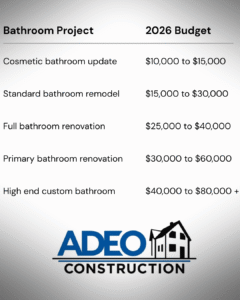
While every project is different, homeowners can use the following ranges as an initial planning guide.
Bathroom Project Typical 2026 Budget
Cosmetic bathroom update $10,000 to $15,000
Standard bathroom remodel $15,000 to $30,000
Full bathroom renovation $25,000 to $40,000
Primary bathroom renovation $30,000 to $60,000
High end custom bathroom $40,000 to $80,000 +
These figures are planning ranges rather than guaranteed project prices.
A local bathroom renovation contractor needs to evaluate the existing bathroom before providing an accurate proposal. The condition of the walls, flooring, plumbing, electrical system, subfloor, ventilation, and waterproofing can all affect the final cost.
Philadelphia area remodeling costs also tend to be affected by the age and construction of local homes. Older properties can require additional work once walls and floors are opened.
The phrase bathroom remodel can mean very different things to different homeowners.
A basic update may involve replacing a vanity, toilet, lighting, mirror, fixtures, flooring, and paint while keeping the existing shower or tub.
A complete bathroom renovation may involve:
The more systems that are changed, the more construction labor is involved.
This is one reason homeowners should be cautious when comparing bathroom remodeling prices online. A $10,000 bathroom update and a $30,000 full renovation may both be described as a bathroom remodel, but they are very different projects.
A larger bathroom generally requires more flooring, tile, drywall, cabinetry, lighting, and labor.
However, size is not the only factor.
A small bathroom can become surprisingly expensive if it requires extensive plumbing changes, custom tile installation, electrical upgrades, or repairs behind the walls.
A five foot by eight foot bathroom with a straightforward existing layout may cost less than a smaller bathroom that requires major reconstruction.
Keeping the existing layout is one of the most effective ways to control construction costs.
Moving a toilet, shower, bathtub, or sink can require plumbing lines to be relocated. Depending on the structure of the home, accessing those lines may involve opening walls or floors.
If you like the current bathroom layout, consider whether changing it is actually necessary.
Moving fixtures can make sense when the existing layout creates a major functional problem. It should not automatically be done simply because you are remodeling.
Tile is another major cost variable.
Basic ceramic tile installed in a straightforward pattern is generally less expensive than custom tile layouts involving intricate patterns, multiple tile sizes, niches, benches, accent walls, or floor to ceiling installation.
Labor matters just as much as the price of the tile itself.
A relatively inexpensive tile can still become an expensive installation when the design requires significant cutting and detailed layout work.
Replacing a standard tub or shower can range from a relatively straightforward installation to a major renovation.
A basic shower replacement may require less work than a custom walk in shower with:
Current Philadelphia area cost data places mid range walk in shower projects at approximately $9,546 to $11,847, while premium installations can cost substantially more.
Plumbing is one of the areas where homeowners should avoid cutting corners.
Replacing a faucet or toilet while keeping the existing plumbing locations is relatively straightforward.
Moving plumbing is different.
If a homeowner wants to move the toilet across the room or relocate the shower drain, additional demolition and plumbing work may be necessary.
Older plumbing can also create unexpected costs once the existing fixtures are removed.
Bathroom remodeling frequently involves electrical work.
This can include new lighting, vanity lighting, outlets, exhaust fans, switches, or other improvements.
If the existing electrical system does not meet current requirements or additional circuits are needed, the project may require a licensed electrician and additional permitting.
Local project requirements can vary by municipality, which is another reason an accurate estimate should be based on the specific property rather than a national cost calculator.
This is one of the biggest variables homeowners cannot always see before demolition.
Water damage, deteriorated subflooring, mold, outdated plumbing, damaged framing, or inadequate waterproofing can become apparent after the existing bathroom is opened.
These issues should not necessarily be viewed as unnecessary costs.
If damaged material is hidden behind a shower wall, replacing the visible tile without addressing the underlying problem can simply leave the homeowner with a renovated surface over an unresolved issue.
A small bathroom does not automatically mean a low cost bathroom renovation.
A small hall bathroom or powder room may cost less because it requires fewer materials and less labor. However, the cost can increase quickly when homeowners select premium fixtures, custom cabinetry, detailed tile work, or make changes to plumbing and electrical systems.
For comparison, current 2026 Philadelphia market data shows small bathroom renovation costs ranging widely depending on scope, with some projects remaining below $15,000 while more involved renovations can move considerably higher.
For a Montgomery County homeowner, the better question is not simply how large the bathroom is.
The better question is:
What exactly needs to be replaced, and what construction work is required to install it correctly?
Primary bathrooms generally have a larger budget because homeowners often want more than a basic replacement.
A primary bathroom renovation may include:
A practical 2026 planning range for a professionally renovated primary bathroom in Montgomery County can be approximately $30,000 to $60,000, with high end projects reaching $80,000 or more.
The final cost depends heavily on the design and whether the existing layout can remain.
Controlling your bathroom remodeling budget does not necessarily mean choosing the cheapest materials.
It means making intentional decisions about where your money should go.
If the toilet, sink, shower, and tub are already positioned correctly, keeping those locations can eliminate significant plumbing work.
Instead of making every element custom, homeowners can focus their budget on one or two features that matter most.
For example, you might choose a custom tiled shower while using a more affordable vanity.
Or you might select premium flooring while choosing standard plumbing fixtures.
Changing material selections after construction begins can create delays and additional costs.
Before work begins, establish the tile, vanity, countertop, plumbing fixtures, lighting, flooring, shower enclosure, and other major selections whenever possible.
Do not compare bathroom remodeling proposals based only on the final number.
Ask whether the proposal includes:
Two contractors can provide very different prices because they are pricing different scopes of work.
Permit requirements depend on the municipality and the work being performed.
For example, Montgomery Township’s 2026 fee schedule specifically identifies existing kitchen and bathroom remodeling and lists additional electrical and plumbing fees.
That is important because Montgomery County is made up of multiple municipalities, and homeowners should not assume that every municipality has identical requirements.
If your project involves plumbing, electrical, structural changes, or other regulated construction work, your contractor should explain which permits and inspections apply to the project.
A properly planned renovation accounts for these requirements before construction begins.
It is common for homeowners to receive two bathroom remodeling estimates that are thousands of dollars apart.
That does not automatically mean one contractor is overcharging.
The proposals may include different materials, labor assumptions, construction methods, allowances, warranty coverage, or scopes of work.
For example, one estimate may include a basic shower enclosure while another includes a custom tiled shower with waterproofing, a bench, niche, and glass enclosure.
The final prices will naturally be different.
The best comparison is to review the scope line by line rather than simply choosing the lowest number.
What Should You Ask a Bathroom Remodeling Contractor Before Hiring Them?
Before signing a bathroom remodeling contract, homeowners should ask:
What exactly is included in the price?
Get the scope of work in writing.
Who handles permits and inspections?
Clarify responsibility before construction begins.
What happens if hidden damage is discovered?
Ask how unexpected conditions are documented and priced.
What materials are included?
Make sure allowances are clearly identified.
Who performs the plumbing and electrical work?
Understand which trades will be working in your home.
What is the expected construction schedule?
Bathroom renovations can temporarily disrupt an essential part of your home. Understanding the expected timeline helps you plan accordingly.
What warranty is provided?
Ask what is covered and for how long.
For homeowners considering a bathroom renovation this fall or planning a project for the upcoming winter and spring seasons, now is a practical time to begin the planning process.
A quality bathroom renovation requires more than choosing tile and fixtures.
Homeowners need time to determine the scope, establish a budget, make selections, obtain applicable approvals, schedule trades, and prepare the home.
Starting the process earlier can also make it easier to make thoughtful decisions instead of rushing material selections.
The actual cost of your bathroom renovation depends on your home, your existing bathroom, the scope of work, and the finishes you select.
If you are planning a bathroom renovation in Montgomery County, ADEO Construction can help you evaluate the project and determine what is required to turn your ideas into a practical remodeling plan.
Whether you are updating a hall bathroom, renovating a primary bathroom, replacing an outdated shower, or completing a larger renovation, the right starting point is a detailed evaluation of the existing space.
Instead of relying on a national bathroom remodeling calculator, get a project specific estimate based on your home and the work you actually want completed.
Many standard bathroom renovations in Montgomery County can fall between approximately $15,000 and $40,000. Larger primary bathroom renovations and custom projects can reach $40,000 to $80,000 or more depending on materials, layout changes, plumbing, electrical work, and the condition of the existing bathroom.
There is no single reliable average because bathroom renovations vary significantly in scope. Current Philadelphia area 2026 cost data places a typical mid range bathroom remodel around $28,237, providing a useful regional benchmark for homeowners in southeastern Pennsylvania.
The biggest cost factors include changing the bathroom layout, relocating plumbing, custom tile installation, premium fixtures, custom cabinetry, electrical upgrades, structural repairs, waterproofing, and hidden damage discovered during demolition.
A $15,000 bathroom renovation may be possible when the existing layout remains unchanged and homeowners select moderately priced materials. A full gut renovation with custom features, extensive plumbing work, or premium finishes will generally require a larger budget.
Keeping the existing layout, limiting plumbing changes, choosing materials early, avoiding unnecessary custom work, and clearly defining the project scope can help control costs without compromising the quality of the renovation.
Yes. Homeowners should compare multiple detailed proposals when appropriate. However, compare the scope of work rather than simply choosing the lowest price. A lower estimate may exclude important work, use different material allowances, or provide a different level of service.
Bathroom remodeling costs in Montgomery County depend on much more than the square footage of the room.
The biggest questions are what you want to change, whether the existing layout can remain, what condition the bathroom is currently in, and what level of materials and finishes you want.
For 2026, homeowners should generally consider $15,000 to $40,000 a reasonable starting planning range for many standard bathroom renovations, while larger primary bathrooms and custom renovations can go substantially higher.
The best way to establish your actual budget is to have the existing bathroom evaluated and receive a detailed proposal based on the specific work required.
For homeowners in Montgomery County and surrounding southeastern Pennsylvania communities, ADEO Construction can help determine the right scope for your bathroom renovation and provide a project specific estimate.